Category Archives: Hydraulic

Starting a Concert off with Elevated Work Platforms

Personally, I am not sure if any concert could ever beat the Christmas shows that the Trans-Siberian Orchestra throws in Grand Rapids each year. A spectacular lightshow paired with a phenomenal blend of classic and rock music produces a performance that completely transports the viewers into the Christmas story being told. Each year they add more and more, making each concert more impressive than the last. Whether this is by adding giant screens to show various images, finding even more lights, using fire along the sides of the stage or adding new lifts to raise the singers and guitar players into the sky, the producers somehow manage to put an even higher level of effort into each unbelievable performance. Continue reading

Posted in Hydraulic, IQS Directory | Tagged , , , , , , , , , , , , , | Leave a comment

The Greek Ergonomics of Hydraulic Lifts

As is true of many ideologies and practices we appreciate and employ today in the twenty first century, we have the Ancient Greeks to thank for the concept of ergonomics. Even the term itself comes from the building block language that has highly influenced modern culture and many modern dialects, including English; ergon means “work” and nomos means “natural laws”. In essence, ergonomics is the science of developing a workspace as well as the tools one uses to work, with the comfort of the worker in mind. Hippocrates wrote of this concept when describing to a young worker how to design his workspace and best lay out tools for surgery. In our modern day world of machine run industry, tools such as hydraulic lifts are ergonomically designed and vital for the safety of workers today. Little did the Greeks know that their idea would develop a variety of lifts used in a wide range of industries, allowing industrial workers to stay healthy and avoid injury. Continue reading

Posted in Hydraulic | Tagged , , , , , , , , , , , , , , , , , | Leave a comment

Make Smooth Moves Through Lubrication Systems

The Wizard of Oz’ is one of the most famous films ever made. Its characters are familiar to many: the Wicked Witch, the Wizard and of course, Dorothy and her companions Toto, the Scarecrow, the Cowardly Lion and the Tin Man. Over the years they have become cultural icons that can be identified by fans of all ages. The Scarecrow, as most people know, desperately seeks a brain while the Lion desires courage. The Tin Man wants a heart but there is also something else that should be on his wish list: a lubrication system. Though that does not fit in exactly with the storyline, this poor woodman suffers from chronic rusting when exposed to rain, tears or moisture. It is a persistent threat for him and indeed, when Dorothy finds him, he cannot speak or move because his joints have rusted shut. Continue reading

Posted in Hydraulic | Tagged , , , , , , , , , , , , , , , , | Leave a comment

Hydraulic Pumps Help Haiti Recover and Rebuild

The 7.0 magnitude earthquake that shook the island nation of Haiti on January 12, 2010 left in its wake a city in ruins. The capital city, Port-au-Prince, was reduced to rubble and residents found themselves searching desperately through the wreckage in hopes of rescuing loved ones. Equipment was needed to cut, spread, lift, pull and separate the tangle of concrete and rebar trapping victims. This machinery was powered by hydraulic pumps. The pumps work by creating pressure enough to move a liquid, often oil or water, through cylinders and hoses thereby creating mechanical energy. This energy is used to run generators, power excavators and hydraulic water pumps even provide water to the Haitian people. Continue reading

Posted in Hydraulic | Tagged , , , , , , , , , , , , , , | Leave a comment

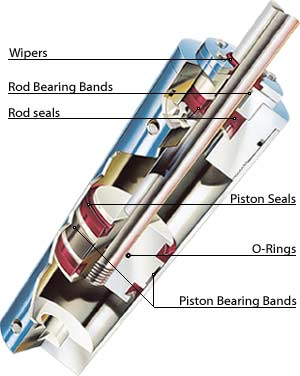
The Simple Design of Hydraulic Cylinders

Do you ever wonder how those heavy duty, high powered equipment vehicles work? I’m talking about tractors, bulldozers, cranes and trucks that lift, push, haul, dump, dig, crush and drill in countless large-scale applications. They harness enormous power to handle extremely heavy loads. You might be surprised, but the main part behind the power-hydraulic cylinders-are probably more simple than they seem, and they don’t require a lot of energy. They use the basic principle of fluid under pressure, and are featured in any system that needs multiple moving parts at once. These cylinders have been around for a while, since the 1970s, and haven’t changed much in design or function. Sure, their manufacturing processes are faster and the tolerances are tighter, but their classic construction still operates just as well with newer machinery as they do with old. Continue reading

Posted in Hydraulic | Tagged , , , , , , , , , , , , , | Leave a comment

Dynamic Seals Help Ease Stress in Hydraulic and Pneumatic Systems

In the most general terms, the function of any kind of seal is to block the passage of liquids or gases. Rubber seals can be either static or dynamic. A static seal does not move and simply contains pressure or maintains a vacuum. The purpose of dynamic seals, however, is to reciprocate a give-and-take with mechanical motion, like for pistons and cylinders or rotating shafts. Mechanical seals are essential components of hydraulic and pneumatic systems, in which constantly moving mechanisms can be under extreme stress. Along with preventing leakage and protecting against contaminants, the mechanical seal helps maintain pressure levels in high temperature, pressure and speed applications. Continue reading

Posted in Hydraulic, IQS Directory, Plastic & Rubber, Pumps & Valves | Tagged , , , , , , , , , , , , , , , | Leave a comment

Hydraulic Motors Handle the Most Extreme Jobs

What do miners, lumber jacks and bull dozer operators all have in common? Besides choosing dangerous heavy duty jobs as occupations, they all work with some pretty powerful and extreme machinery everyday. Their equipment, along with trenchers, marine winches, cranes and car crushers, use intense amounts of power to do their job. But where does energy powerful enough to flatten cars or move massive amounts of earth come from? The answer is hydraulic motors-components of hydrostatic power transmission systems that convert hydraulic energy into mechanical energy. These motors are able to harness the immense power generated from fluid pressure and supply energy to the most massive and extreme machines. Continue reading

Posted in Hydraulic | Tagged , , , , , , , , , , , , | Leave a comment

Without Hydraulic Presses Manufacturing as We Know it Would Cease

The full range of today’s hydraulic presses is some of the most powerful and versatile manufacturing equipment. Achieving the highest compressive force of all the power presses, these machines are crucial for the forming and molding of a wide spectrum of materials: metals, plastics and composites, rubber, wood, and laminates. From deep drawing essential parts, such as tanks and fenders, for the production of motorcycles to creating 2,640 plastic credit cards per hour, the manufacturing realm would be lost without hydraulic presses. The scrap metal processing industry also relies on shear hydraulic press force to smash discarded cars and such into compact, manageable squares of reusable material for pop cans, paper clips, etc. Continue reading

Posted in General Industry Articles, Hydraulic, IQS Directory, Plant & Facility, Process Equipment | Tagged , , , , , , , , , , , , , , , | Leave a comment

Introducing R3F Technology to Filtration Systems

The current types of water filtration systems dominating the market today-multimedia, screen or fixed barrier, disposable and membrane filters-may soon have a tough competitor. Undergoing testing at the US EPA in Cincinnati and the University of Alberta, R3F, or radial flow fluidized filter technology, is yielding very positive results. R3F filters could soon be available to manufacturers for the municipal, industrial and agricultural sectors of filtration systems. This filtration equipment uses both radial flow cartridge and non bonded media in the form of small, spherical glass beads. It is similar to microfiltration technology, but has significant cost and operational benefits. University of Alberta testing found that as they used smaller and smaller media (glass beads), the percentage of small particles were separated from the filtered water, a benefit known as selective removal, which is used to remove cysts and pathogens. The glass beads are as efficient as using sand, but more cost effective. Continue reading

Posted in Hydraulic | Tagged , , , , , , , , , , , , | Leave a comment

Lubrication: The Greener The Better

Manufacturing practices are becoming increasingly more scrutinized for their effect on the environment. Real changes are underway in the area of emissions, byproducts, packaging materials, fluid selection, and power consumption – to name only a few. While environmental payback may be the goal, many of these initiatives encounter obstacles, not the least of which is additional operational costs. Not so with lubrication – the greener the better. Utilizing very small amounts of lubricant at controlled intervals is productive for a number of reasons… Continue reading

Posted in Hydraulic, White Papers | Tagged , , , , , , , , , , , , , , | Leave a comment